
Omofuma:
Framing
Breathing
Movement
Borders
Sophia Glinka
Austrian immigration courts, Schwechat/ Vienna Airport, Balkan Air flight LZ 462 in/between Vienna and Sofia; 1st May 1999: Marcus Omofuma‘s asylum claim is rejected in the second instance. Immigration authorities are ordered to deport him. On the way from the detention facility to the plane, Omofuma struggles. The three policemen detaining him — Bingler, Rosner, Kreuzberger — shackle his arms and legs with Velcro, tape his mouth with Leukoplast and parcel tape, carry him into the plane and tape his upper body and head to the seat. Although the man can hardly move at this point, the officers try to completely immobilize him by putting another tape on his chest and pulling from behind for an undetermined time. Omofuma’s legs still move, hitting the seat in front of him. Reacting to the commercial flight’s passengers’ complaints, the police lash his legs back as well. During the flight, anytime Omofuma makes another sound or groans, the policemen add another layer of tape to his thorax, until his cloth isn’t discernable underneath anymore. After 25 minutes – around half the flight – Marcus Omofuma is unconscious. Bingler, Rosner and Kreuzberger make no move to check vital functions. Upon arrival, the airport physician declares the point of death as 20-25 minutes before arrival.1 A local coroner, Prof. Radanov, reports the cause of death as “mechanically induced asphyxia due to constriction of the airway, possibly in combination with neck soft tissue and chest compression” on May 3, 1999.2
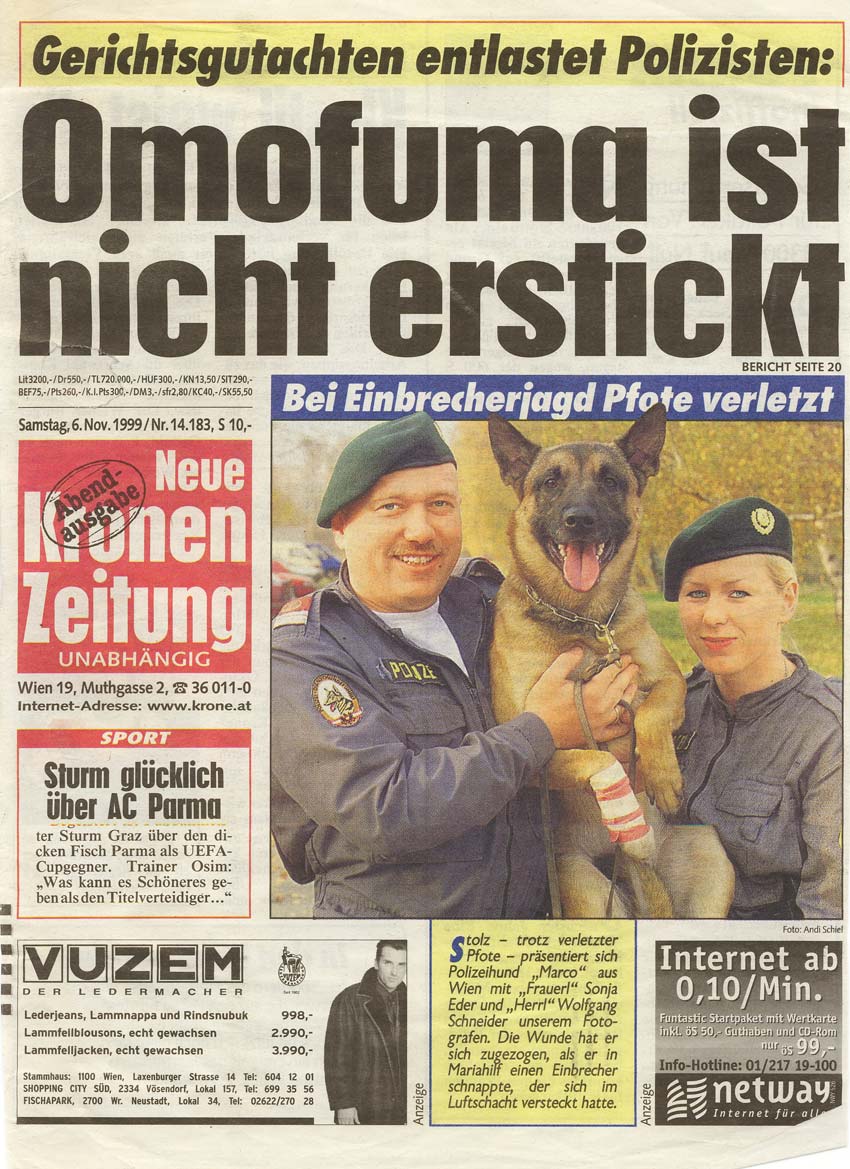
“Marcus Omofuma did not suffocate”, the Kronenzeitung titles read on November 6, 1999. Beneath it, a photo of an injured police dog, lovingly held by his uniformed caretakers. What gave rise to this was a second obduction, performed by Austrian coroner Christian Reiter on May 16, 1999. Reiter stipulated that Omofuma’s death could not unequivocally be said to be the consequence of the officer's conduct, instead suggesting it to be caused by a pulmonary fat embolism that, paired with Omofuma’s prior cardiac insufficiency and a state of excitement, lead to cardiac failure. Although this may seem ridiculous when taking into account that the other two examinations debunked both the pulmonary fat embolism and myocarditis diagnosis,
Reiter’s statement echoes a pattern of descriptions of Black deaths observable in recent years.4 The myth of Black bodies killing themselves, pushed, for example, through concepts like excited delirium in the US, is a persistent one. While this questionable diagnosis is not commonly used in Europe, similar characteristics from the defense's side and Reiter’s report are obvious: victim blaming through the invocation of the victims “excited state” as a factor of death, pathologization and dehumanisation. Effectively, this narrative turns victims into perpetrators of their own killings. Instead of the polices’ action, it is the resistance to it that is framed as harmful, undermining righteous resistance, in this case the struggle to breathe, to live, as violent, volatile, wrong. At the same time, the inherent violence of the proceedings – born out of the baseline violence of borders that implies forceful removal of the illegalised – and the specific violations that the police perpetrates in each case, are ignored, even divorced completely from the deaths. As a consequence, state violence continues unsanctioned; After the charge of torturing a detainee was dropped, the three immigration officers that killed Marcus Omofuma were sentenced to eight months on probation — a verdict that allowed them to stay in service as policemen.5
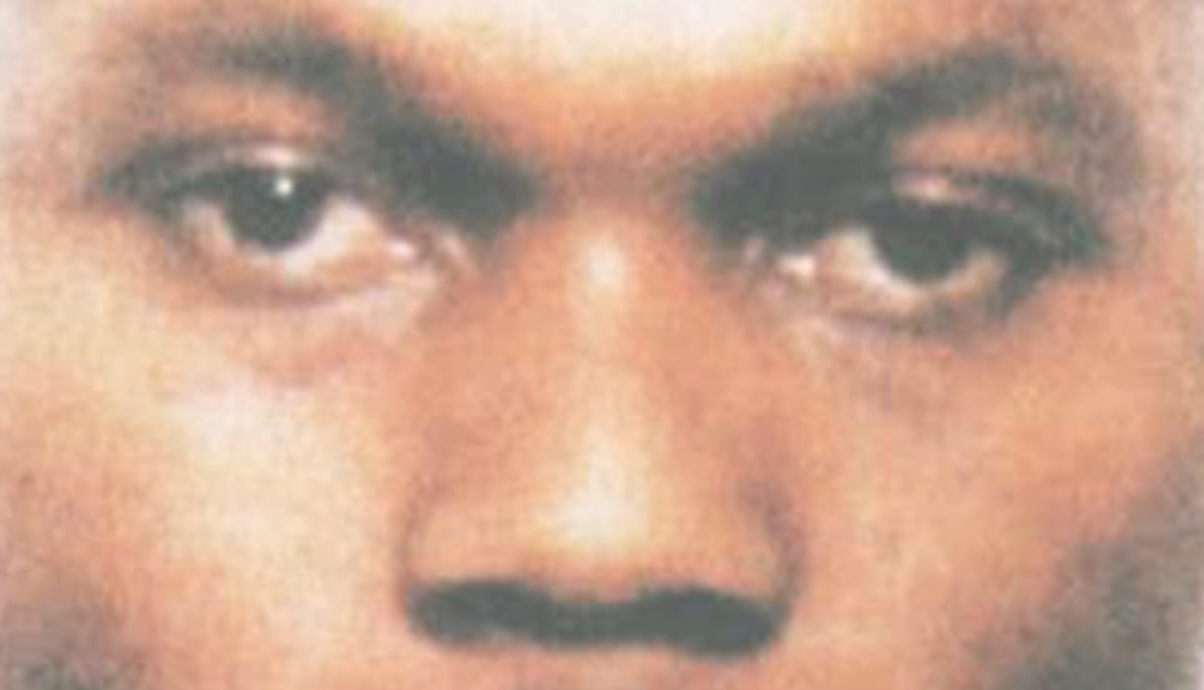

Across borders, voluntary and forced;
constrained
in defiance,
involuntary,
reflexive,
active;
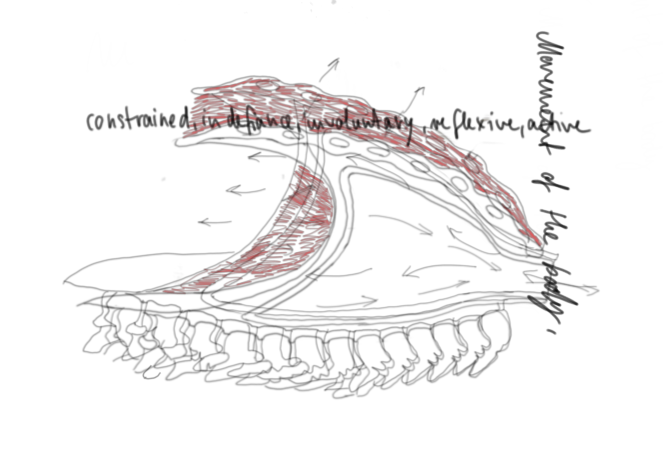
movements of resistance
against a racist state apparatus,
involuntary,
marches for justice.

a title page
moving the masses.

oxygen, people,
constricted by
an apparatus of state violence.
A human,
bound like a parcel
to be sent back to a purported origin,
now: a question of logistics.
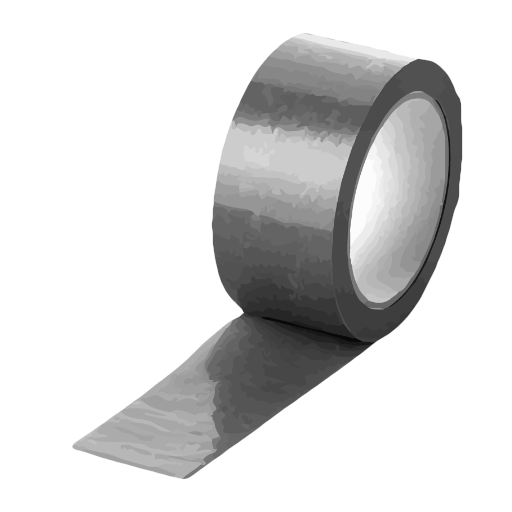
discursive sorting
of what is
il/legal, in/human or non/life.8
phenomena, they aren’t static,
not absolute,
never once-and-for-all.
1: no-racism.net, “Das Urteil.” no- racism.net, 2013. http://web.archive.org/web/ 2013062420 1400/http://no-racism.net/article/ 303/.
2: D. Brinkmann, “Rechtsmedizinisches Gutachten zur Frage nach der Todesursache des Marcus Omofuma”, 8ung.at. 23.01.2001, website from June 22, 2003. http://web.archive.org/ web/2003062218 2455/http://www.8ung.at/ gutachten/.
3: D. Brinkmann, “Rechtsmedizinisches Gutachten zur Frage nach der Todesursache des Marcus Omofuma”, 8ung.at. 23.01.2001, website from June 22, 2003. http://web.archive.org/ web/2003062218 2455/http://www.8ung.at/ gutachten/.
4: Patricia Williams, “Language Is Part of the Machinery of Oppression – Just Look at How Black Deaths Are Described,” The Guardian (Guardian News and Media, June 10, 2020), https://www.theguardian.com/comment isfree/2020/jun/10/language-is-part-of- the- machinery-of-oppression-just-look- at-how- black-deaths-are-described.
5: no-racism.net, “Das Urteil.” no- racism.net, 2013. http://web.archive.org/web/ 2013062420 1400/http://no-racism.net/article/ 303/.
6: Suvendrini Perera and Joseph Pugliese, “Introduction: Combat Breathing: State Violence and the Body in Question,” Somatechnics 1, no. 1 (March 2011): pp. 1-14, https://doi.org/10.3366/soma.2011.0002 , 2.
7: William Walters, ‘Deportation, Expulsion,and the International Police of Aliens’, in The Deportation Regime; Sovereignty, Space and the Freedom of Movement, ed. Nicholas De Genova and Nathalie Peutz. (Durham, NC:Duke University Press, 2010), 83.
8: Debarati Sanyal, “Race, Migration, and Security at the Euro-African Border,” in Theory & Event 24, no. 1 (January 2021): 324-355, 330.
9: Etienne Balibar, “Europe as Borderland,” n Environment and Planning D: Society and Space (2009), vol 27: 190 – 215, doi: 10.1068/d13008, 192.
10: Karen Barad, “Diffracting Diffraction: Cutting Together-Apart,” Parallax 20, no. 3 (March 2014): pp. 168-187, https://doi.org/ 10.1080/13534645.2014. 927623, 175.